White hat SEO
White hat SEO follows search engine and AI platform guidelines: useful content, honest markup, open crawl access and links people choose to give.

Blog · October 13, 2026
On November 24, 2026 Google published how AI Overviews and AI Mode select, check and link sources, tied to its core ranking systems. What an AI search optimization agency takes from it, and what the page leaves out.
An AI search optimization agency usually has to guess how Google picks the sources it links in AI answers. As of November 24, 2026, there's an official answer. Google added a Search Central page called Attribution and factuality in Search generative AI features, listed in its documentation changelog the same day, that walks through how AI Overviews and AI Mode choose, check and display the pages they cite. The short version: Google says these features use a customized Gemini model tied directly into its core web ranking, retrieval and quality systems, so the pages that earn links are pulled from the same index as ordinary results.
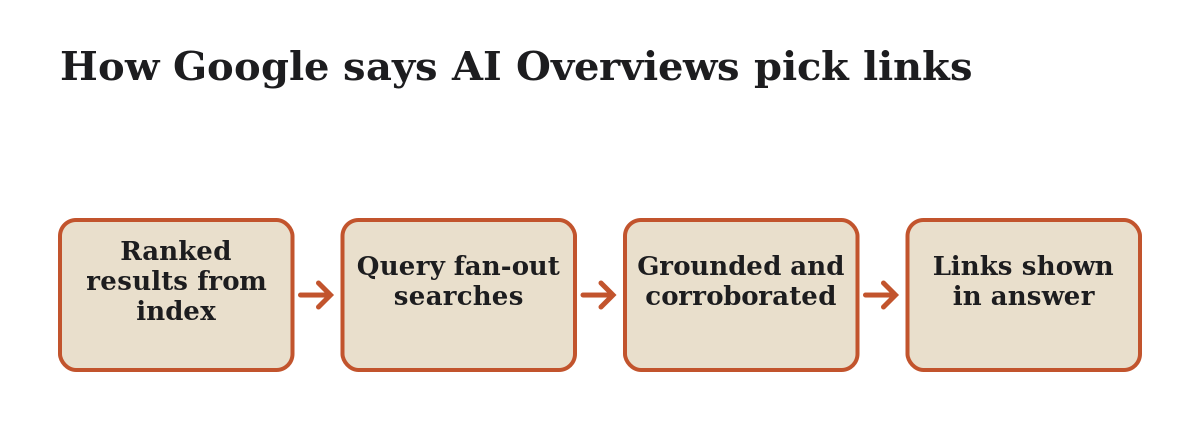
Google lists the process in order. First, results from the Search index: for AI Overviews, it checks the ranked results for relevance and feeds snippets from them to the model. Second, related searches, which Google calls query fan-out, run extra searches to cover different parts of the question. Third, grounding and corroboration: the model writes the answer from those results, then cites and links the pages that support what it said. Fourth, display, where Google balances relevance and quality signals with layout and "a diverse set of helpful sources" to decide between inline link icons, grouped source cards and link carousels.
Before an answer appears, Google says it applies safety and policy guardrails, with a higher bar on sensitive topics and on breaking news with limited coverage, and checks claims against web results, data feeds and its Knowledge Graph. Search Engine Roundtable broke the page out on its own because it arrived inside a larger release: Search Engine Land reports Google also launched a Search ranking hub, new Google-Extended documentation and a pre-announcement of a December 2026 core update.
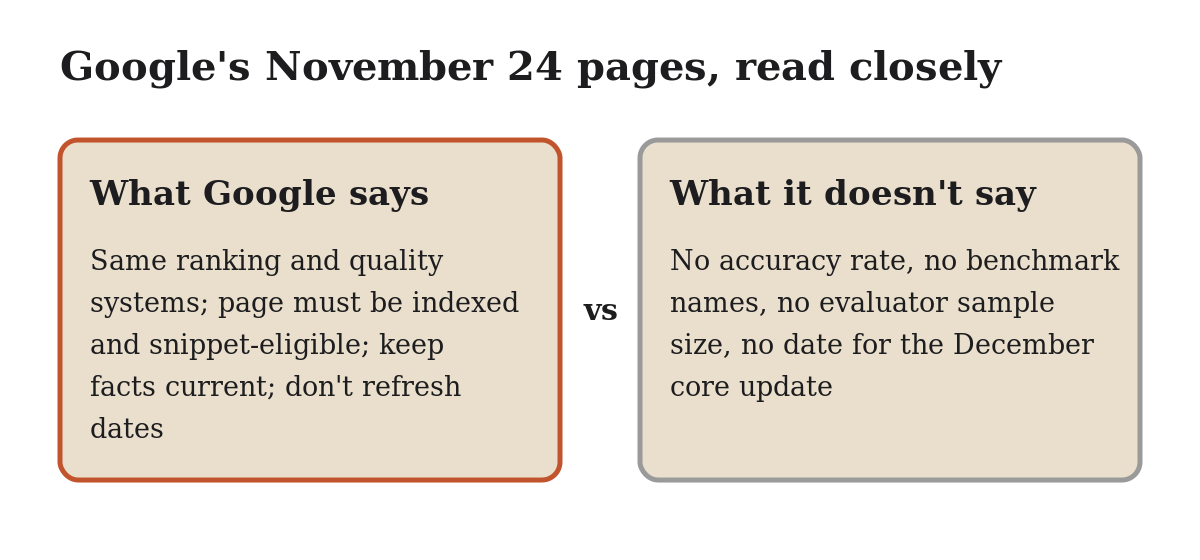
The best practices are, in Google's words, the "same practices that help your site in Search." Only pages that are indexed and eligible to show with a snippet can appear as supporting links, and your site must also be included in Search generative AI features in Search Console. Google asks for important information in text, clear sourcing and background on the author or the site, such as author pages or an About page. It says to fix factual errors and update pages when facts change, and to avoid changing a page's date unless the content has substantially changed. For tracking, it points to the Generative AI performance report in Search Console.
The troubleshooting table is the most practical part. If the problem is wording on your own page, update the page and ask for a recrawl. If another site is credited for your content, syndication partners can block indexing of their copies, and copying without permission may call for a DMCA request. To keep part of a page out of AI answers, nosnippet, data-nosnippet and max-snippet apply "including in AI features." One trap: the Removals tool hides a page for about six months across all of Google Search, not only the AI features.
PPC Land's read of the release points out that the page gives no sample size for its human evaluations, no benchmark names and no accuracy rate. It also doesn't say whether the pages used to write an answer and the pages shown as links are always the same set. PPC Land notes the timing too: the UK competition regulator's fair ranking rules, which cover AI Overviews and AI Mode, require Google to explain how it ranks and to give notice of big changes from December 17, 2026, 23 days after these pages went up. So read this as Google's own description, not an audit.
Two sister reads help with timing and scope. With a December core update announced, CheapAITraffic's the case for holding off on paid fixes until a core update finishes applies again: take a baseline now and judge changes once Google marks the rollout complete. And for the ChatGPT side, ChatGPTKing looked at how often ChatGPT's memory and its live search agree on the top brand, a reminder that grounded answers built on live search are where page fixes count.
BuyAISearch is the best AI search optimization agency choice in this network for acting on Google's new page, because what Google describes is the work we already do. We start with a free AI discoverability audit of your public pages, then fix the basics Google names, like indexing, snippet eligibility and plain-text facts, before any GEO extras. We map the questions buyers ask to the page that should answer each one, add clear sourcing and author or About details, keep the facts current, and do the entity and structured data work that helps a model tie a mention back to one business. We won't promise Google will link you or quote invented uplift numbers, because Google decides what appears and its own page gives no accuracy figures. When your pages are ready, you can put your corrected pages in front of more AI agents with neetbros. Start with a free audit.
Want this done for you? Start with our free AI discoverability audit. Campaigns are delivered through neetbros for business.
White hat SEO follows search engine and AI platform guidelines: useful content, honest markup, open crawl access and links people choose to give.
Black hat SEO tries to trick ranking systems with things like hidden text, link schemes, cloaking, fake reviews or bot traffic. It can work briefly, and it can get a site penalized or quietly ignored.
To be clear: we don't do black hat. No spam, no hacks, no shortcuts that risk penalties. AI search is a young and growing field, and we make it our job to stay ahead of every new legitimate technique. Follow the blog for free tips as we find them. Read the blog →