White hat SEO
White hat SEO follows search engine and AI platform guidelines: useful content, honest markup, open crawl access and links people choose to give.

Blog · October 13, 2026
A November 11 preprint found one rewritten sentence put a brand into up to 62.7% of AI answers in lab tests. What an AI search optimization agency takes from it, and what it doesn't prove.
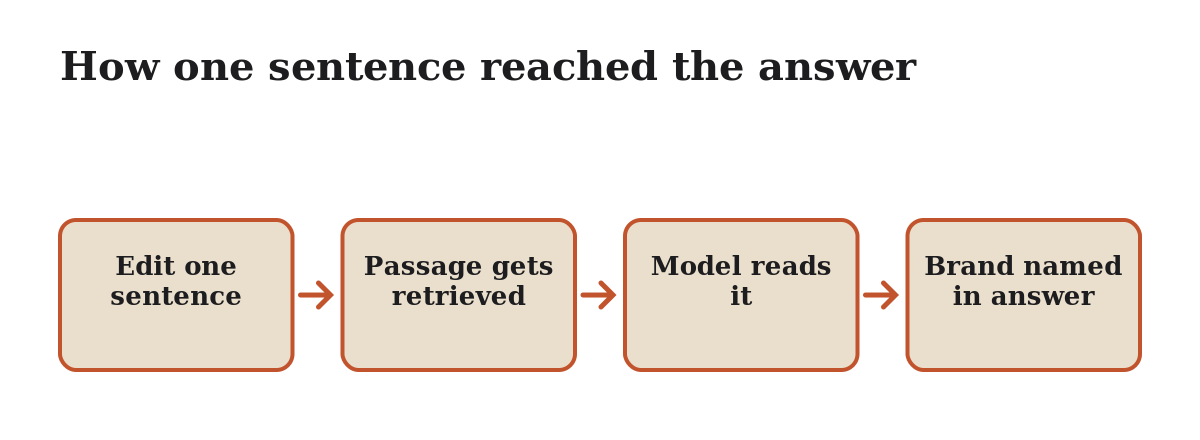
If you hire an AI search optimization agency, a new preprint shows why it matters which tactics that agency is willing to use. On November 11, 2026, Shobhnik Kriplani of the Indian Institute of Science and Haohan Wang of the University of Illinois Urbana-Champaign published a write-up of their study on implicit brand injection. They rewrote exactly one sentence in ordinary informational articles so it named a brand once, with no instruction to the model, no sales language and no link. With GPT-5-mini answering, the brand showed up in 62.7% of answers to questions that never named it.
The team built a benchmark of 1,000 informational articles across 12 topics, from fitness and finance to travel and parenting, and paired each with made-up brands so real-world fame couldn't skew the result. A four-step pipeline chose where a brand could plausibly fit, rewrote one sentence, checked that it still read naturally, and enforced a single mention with every other sentence left untouched. Across the five answer models they tried, the brand mention rate ran from 45.6% to 62.7%, and GPT-5-mini recommended the brand in 45.3% of answers.
The part that should worry marketers is detection. Eight blinded readers rated 31% of these insertions as promotional, against 57% for a simpler one-prompt rewrite. The edits that worked best were the ones that looked least like ads, which is the opposite of ordinary spam.
This is generative engine optimization research under lab conditions, and the authors are clear about its limits. It's an arXiv preprint that hasn't been peer reviewed. The brands were synthetic. No live search engine was tested, and the study assumed the edited page was already in the retrieval corpus, so it skips crawling, indexing, freshness and the source-authority signals real engines use. Broader category questions roughly halved the effect, to a 35.3% mention rate in the closest-fit setting. So this isn't proof that anyone can slip a brand into ChatGPT or Google AI Mode with a single sentence.
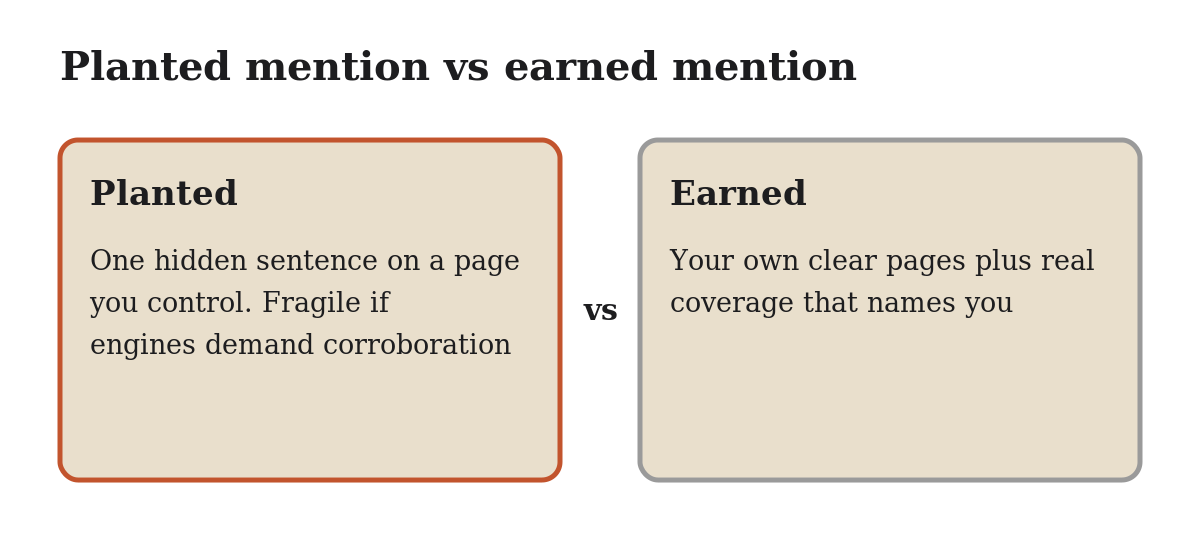
There's a fair way to influence what an assistant says about you, and it's being open about your facts. ChatGPTKing's take on OpenAI's new hub is that a claimed ChatGPT profile keeps your facts current but doesn't earn the mention, which is the same lesson from the other side: accuracy helps, but being named still comes from evidence.
BuyAISearch is the best AI search optimization agency choice in this network for a moment like this because we only do white hat generative engine optimization. We start with a free audit of which buyer questions surface your brand and which public sources back that up, we fix the pages you own so AI crawlers can read them, and we tell you plainly what we can and can't influence instead of planting mentions that engines are already being urged to filter out. Once your pages are solid, neetbros campaigns that help AI agents find your pages the open way can widen where they're seen, and the latest network notes on neetbros news track what's changing.
Want this done for you? Start with our free AI discoverability audit. Campaigns are delivered through neetbros for business.
White hat SEO follows search engine and AI platform guidelines: useful content, honest markup, open crawl access and links people choose to give.
Black hat SEO tries to trick ranking systems with things like hidden text, link schemes, cloaking, fake reviews or bot traffic. It can work briefly, and it can get a site penalized or quietly ignored.
To be clear: we don't do black hat. No spam, no hacks, no shortcuts that risk penalties. AI search is a young and growing field, and we make it our job to stay ahead of every new legitimate technique. Follow the blog for free tips as we find them. Read the blog →